Dental education
Why the chair, not the textbook, makes a dentist
Books teach you what a caries lesion looks like. Only a patient teaches you what it feels like when your hand is inside their mouth and the clock is ticking. In the UAE, where dental schools follow international accreditation standards, clinical practice is treated as the backbone of training, not an add-on at the end.
The core idea
Theory, simulation, then patients
A future dentist moves through three overlapping stages: classroom learning, work on phantom heads and typodont models, and finally supervised treatment of real patients. Skip any stage and the training loses its shape.
Years
5 to 6
Typical length of a Bachelor of Dental Surgery programme in the UAE, including an internship year.
Supervised hours
Hundreds
Clinical rotations account for a large share of final-year study, with students treating patients under faculty guidance.
Post-graduation
2 to 3 years of mentored work
Most new UAE-licensed dentists spend their first years working alongside senior clinicians before running a chair independently. It is the bridge between passing exams and being genuinely ready.
Regulator
DHA / DoH / MOHAP
Licensing bodies across Dubai, Abu Dhabi and the northern emirates require documented clinical experience before granting a full practice permit.
Stage one
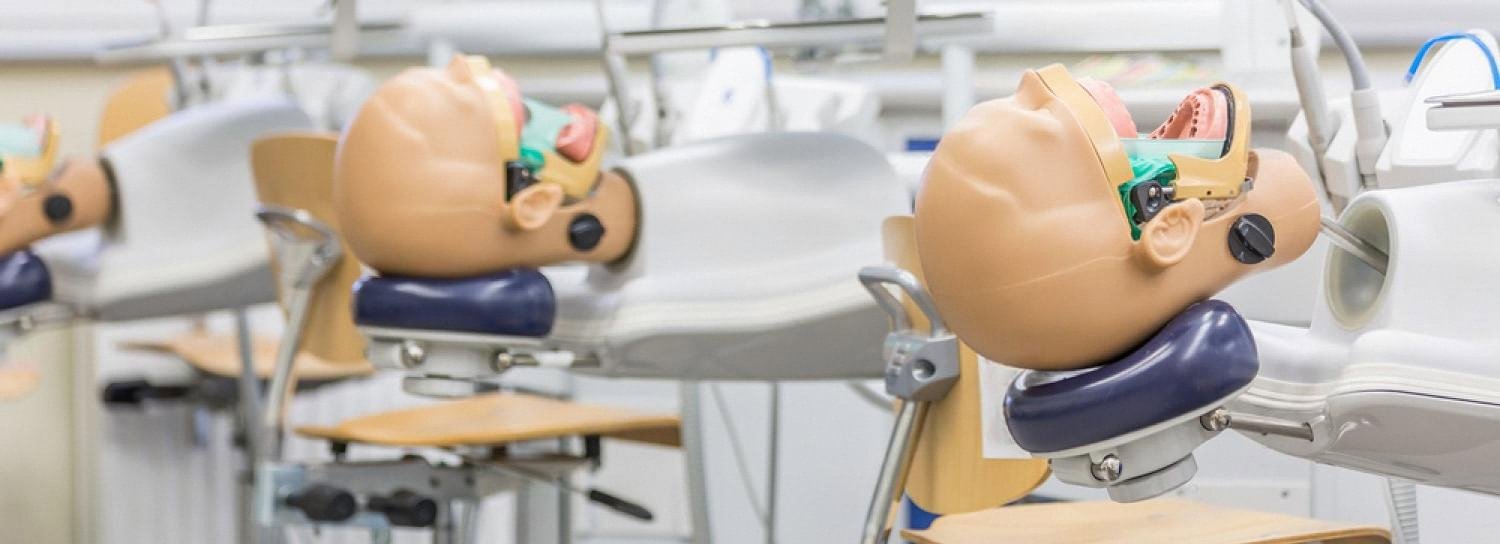
Phantom heads before real jaws
Before a student touches a patient, they spend months in a preclinical lab drilling, filling and shaping teeth on plastic jaws mounted in mannequin heads. It looks a bit like a dentist’s version of a driving simulator, and that comparison is fair. The whole point is to make mistakes safely.
This stage builds the small motor habits that a dentist relies on for the rest of their career: how to hold a mirror, how to angle a handpiece, how to read tactile feedback through a probe. According to the World Health Organization oral diseases affect close to 3.5 billion people worldwide, so the skills built at this bench will be used constantly.
Stage two
Working on patients, with a mentor at the shoulder
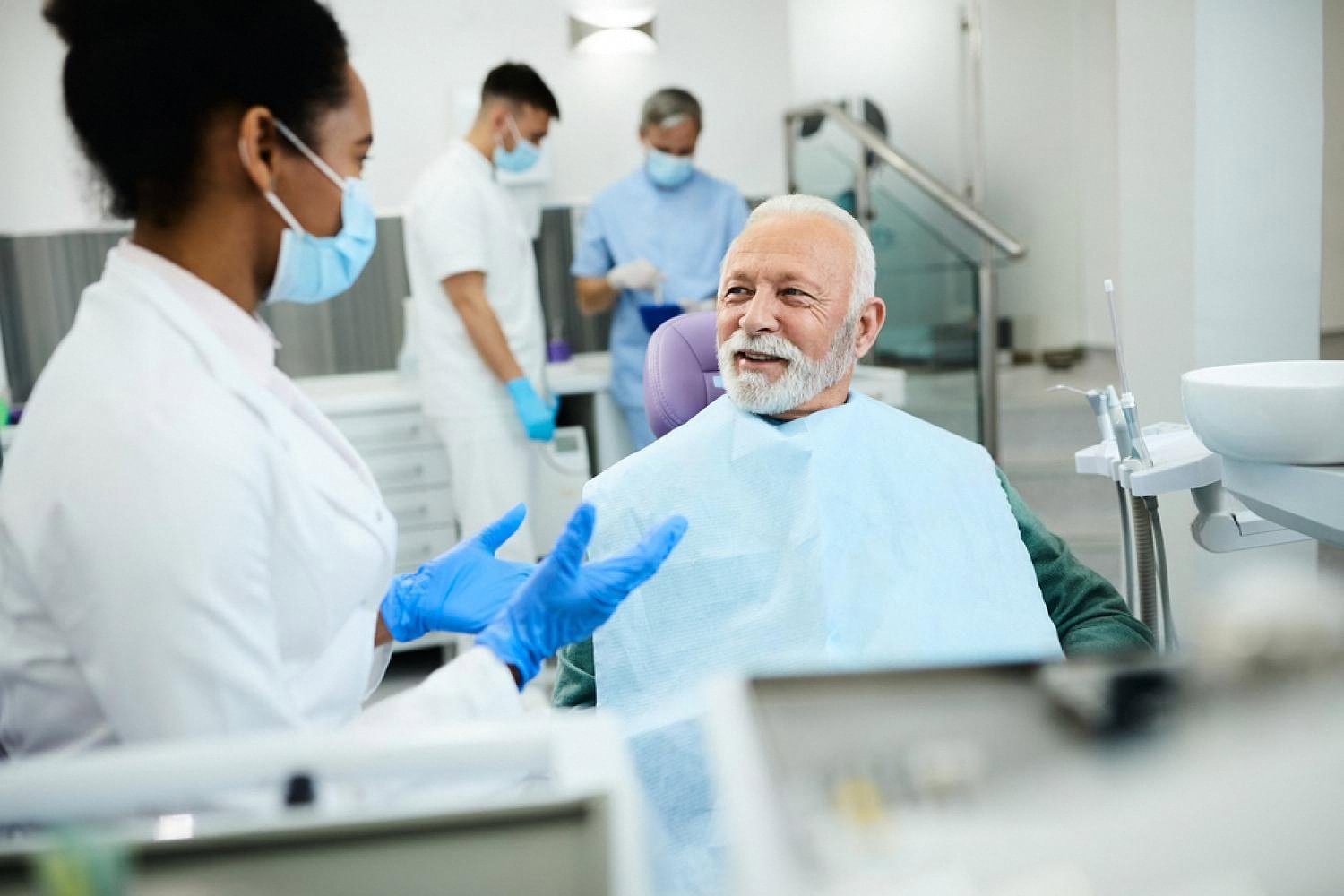
Around the third or fourth year, students move into teaching clinics attached to their university. Real patients, real diagnoses, real consent forms. What changes the game is the presence of a supervising clinician who signs off on every step, from treatment plan to final polish.
Mentorship at this stage is not a formality. A senior dentist watching a scaling procedure will spot a wrist angle that risks injuring the patient’s gum, catch an X-ray that was read too quickly, or notice that the student rushed the anaesthetic. Those small corrections compound into competence.
“A graduate who has read every textbook but treated only mannequins is not a dentist yet. Two or three years of supervised chair time is what turns a licence into a career.”
What clinical practice actually teaches
- Reading a person, not just a chart. Anxious patients tense their jaw, cough during impressions, and forget half of what you told them. You learn to slow down, explain again, and adjust.
- Handling the unexpected. A tooth that looked straightforward on radiograph turns out to have a curved root. The seal on a temporary crown fails at day three. Textbooks describe these cases; the clinic teaches you how to recover from them.
- Time management. A 45-minute slot is a real constraint. Trainees learn to sequence a procedure so nothing important gets rushed at the end.
- Documenting properly. UAE regulators, and any future insurer or lawyer, will read the notes. Clear, honest charting is a clinical skill in itself.
- Knowing when to stop and ask. The best trainees are not the ones who never hesitate, they are the ones who call the supervisor over at the right moment.
Why it matters here
The UAE context
- Diverse patient base. Clinics in Dubai and Abu Dhabi see patients from dozens of countries, with different oral health histories and expectations. Trainees learn to adapt communication and treatment planning on the fly.
- Fast-moving technology. Digital scanners, CAD/CAM crowns and CBCT imaging are common in UAE practices. Clinical rotations are where students first touch this equipment on a paying patient rather than a demo model.
- Strict licensing pathway. DHA, DoH Abu Dhabi and MOHAP each verify clinical hours and, for foreign-trained dentists, often require an assessment or supervised period before independent practice is allowed.
- Public health load. Studies published via the National Library of Medicine report high rates of dental caries among UAE schoolchildren, which means new dentists face real, high-volume caseloads early on.
The honest version of dental training is that it never really ends. A graduate who took the internship seriously and then spent two or three years in a group practice under an experienced principal is a very different clinician from one who opened a solo chair the week after licensing. Patients feel that difference, even if they cannot name it.
Continuing education, hands-on courses in implantology, endodontics or orthodontics, and case reviews with peers all extend the same idea: theory holds knowledge in place, but practice, under someone who has already done it, is what makes that knowledge safe to use.
Frequently asked questions
How many years does it take to become a dentist in the UAE?
Most UAE dental programmes run five years of academic and clinical study followed by a one-year internship, so the total is typically six years before applying for a licence. Many graduates then work under supervision for another two to three years before practising fully independently.
Is clinical practice really more important than theory?
They are not in competition. Theory tells you what the disease is and why treatment works, and clinical practice teaches you how to deliver that treatment in a real mouth, in a real time slot, on a real person. A dentist trained on only one side of that pair will struggle. The strongest graduates are the ones who kept the two connected throughout their studies.
What is the point of practising on phantom heads before real patients?
Phantom heads let students repeat the same procedure dozens of times without any risk to a patient. That is how tactile skill and speed develop. By the time a trainee touches a real jaw, the basic motor patterns are already there, so their attention is free for the human side of the appointment: communication, comfort, and problem solving.
Do new UAE dental graduates work alone straight after licensing?
In practice, no. Most join a clinic where a senior dentist reviews their cases, especially in the first years. Regulators such as the DHA, DoH Abu Dhabi and MOHAP also structure the licensing pathway so that early-career dentists build documented experience before taking on complex procedures independently.
How much of dental study time is spent in clinics rather than lectures?
The balance shifts each year. Early years lean heavily on lectures, anatomy and preclinical simulation. From the third or fourth year onwards, clinical rotations grow steadily, and the internship year is almost entirely chair-side. By graduation, a serious student will have logged hundreds of supervised patient contact hours.
Can foreign-trained dentists practise in the UAE without additional supervised work?
It depends on the country of qualification and the emirate. Applicants usually go through credential verification and an assessment exam, and in many cases a supervised period is required before a full independent licence is issued. The reasoning is the same as for local graduates: patients are better served when new arrivals prove their clinical skill on the ground, not just on paper.

Skier, father of 3, drummer, Bauhaus fan and doodler. Operating at the junction of minimalism and function to craft experiences both online and in real life. Let’s make every day A RAZZLE-DAZZLE MUSICAL.